











SolGuruz Logo
Pricing

AI PoC Development Services

Prove your AI idea works on your own data before you commit a full budget.An AI proof of concept answers one question: can this actually be built, on your data, to a standard worth shipping? SolGuruz builds working AI PoCs in 2 to 6 weeks, tested against an agreed evaluation set so the result is a defensible go or no-go decision rather than a demo that impresses in a meeting and fails in production.Generative assistants, retrieval systems, autonomous agents, document intelligence, computer vision and predictive models. We build the riskiest part first, measure it honestly, and tell you what the number means.
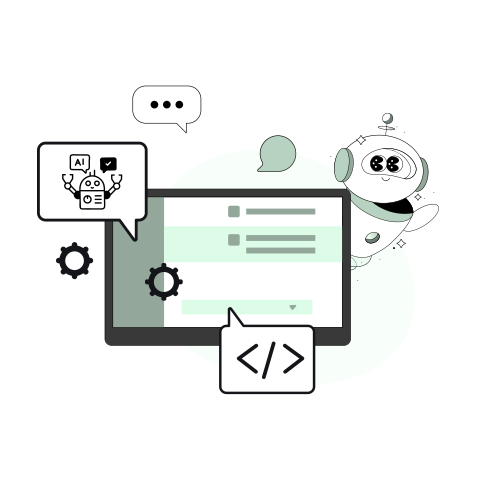
AI model under evaluation beside a dashboard showing benchmark scores
  • Flexible Engagement Models
  • Strict NDA
  • 1 Week Risk-Free Trial

An AI-Native Engineering Team

We build AI into real products, with a team that runs AI tooling across every stage of delivery.

7+

Years Building Custom Software

7

Dedicated AI and ML Teams

102+

Products Delivered Across Apps, Web & Software

87+

Clients Served Across 17+ Countries

Trusted by Startups and Enterprises Worldwide

What Is an AI PoC, and What Does It Actually Prove?

An AI proof of concept is a small, time-boxed build that tests whether your AI idea is technically feasible on your real data. It runs against an agreed evaluation set with a threshold set in advance, so the outcome is a number you can act on rather than an opinion.

What a PoC proves

Technical feasibility on your data. A PoC targets the single assumption most likely to sink the project, usually whether the model performs well enough on your examples rather than on a public benchmark.

What a PoC does not prove

That anyone wants the product. Demand is a question an MVP answers, and building an AI MVP is a different exercise. A PoC is also not a production system, so treat the code as evidence rather than as a foundation to build on.

Why a failed PoC still counts

A PoC that fails is a successful PoC. It cost weeks instead of quarters, and it stopped a build that would not have worked. That is the cheapest no you will ever buy.

AI PoC vs AI Pilot vs MVP: Which One Do You Need?

These three get used interchangeably and they answer completely different questions. Building the wrong one is the most expensive mistake at this stage.

AI PoC: can it be built?

Tests technical feasibility on your data, usually in private, over 2 to 6 weeks. Success is a measured result against an agreed threshold. Nobody outside the team uses it. For products without an AI component, see our PoC development services.

AI pilot: does it hold up in the real workflow?

Takes a feasible model and puts it in front of a controlled group of real users, with monitoring. Tests reliability, latency, edge cases and whether people trust the output enough to use it.

MVP: will anyone pay for it?

A working product sold to real customers. Tests demand, not feasibility. Only worth building once the PoC and pilot have answered the questions above, which is where MVP development services take over.

Custom Software Development Success Stories

Hear It Directly From the Founders Who Built With Us

Real founders, CEOs, CTOs, and product owners behind 102+ shipped products across 14 industries share what working with SolGuruz looked like. Every story is one of 133+ independently verified client reviews across Clutch, Google, Glassdoor, and other platforms, averaging 4.9 ★★★★★ ratings.

Frame 01 / 04

Custom Software Solution Development / Driver Dashboard & Invoice Automation for Food Service Company

SolGuruz has delivered a solution that has reduced 90% of manual efforts through automation and provided real-time insights for supplier fulfillment and order volume trends. The team is responsive to requests and changes, and their proactive approach to problem-solving has stood out.

Summarized from Gary Boyd's Clutch review

Gary Boyd

CEO and Owner, Tasty Food Guys | Florida, USA

Read Clutch Verified Review
Tasty Food Guys

SolGuruz is Rated by Real People on Google and Clutch

SolGuruz Google Reviews
5.0

Rated 5.0 / 5 on Google by clients, partners, and visitors who have experienced SolGuruz first-hand - through our work, our office, or our team.

Read Google reviews →
SolGuruz Clutch Reviews
4.9

4.9 / 5 on Clutch - independently audited reviews from real clients who have shipped products with SolGuruz.

Read Clutch Reviews →

Backed by independent accreditations

Types of AI PoC We Build

Each type isolates a different risk. We start with the one most likely to stop the project.

01

Generative AI Assistant PoC

Tests whether a generative AI model can produce output good enough for your domain, tone and accuracy bar. We measure against a scored sample rather than a handful of impressive examples.

02

RAG and Knowledge Retrieval PoC

The most common AI PoC and the one that fails most often. Tests whether retrieval augmented generation can chunk, embed and retrieve your documents accurately enough to answer real questions without inventing facts.

03

AI Agent and Automation PoC

Tests whether an AI agent can complete a multi-step workflow reliably, including what happens when a tool call fails. Reliability across a run matters more than a single successful demo.

04

Document Intelligence PoC

Extraction and classification tested on your actual documents, including the scanned, rotated and badly photocopied ones that never appear in a vendor demo.

05

Computer Vision PoC

Detection, classification or inspection tested under your real lighting, angles and hardware. Accuracy on a clean public dataset predicts very little about accuracy on a factory floor.

06

Predictive and ML Model PoC

Tests whether your historical data carries enough signal to predict what you need, and whether the accuracy clears the bar that makes the decision worth automating. Proven models move on to machine learning development.

Not sure which part of your AI idea to test first?

Tell us the idea and we will name the riskiest assumption, then scope a PoC around it.

When Do You Need an AI PoC?

Five signals that a PoC is the right next step rather than a full build.

The model has never seen data like yours

Benchmarks are run on clean public datasets. Your data has gaps, inconsistent formats and edge cases nobody documented. That difference is where most AI projects fail.

Leadership needs evidence, not a deck

A working result on real data moves a budget conversation in a way that a vendor demo cannot.

You are choosing between approaches

Fine-tuning against retrieval, one model against another, build against buy. A PoC settles it with a measurement instead of an opinion.

The accuracy bar is unclear

If nobody has agreed what good enough means, a PoC forces that conversation before it becomes an argument at launch.

Compliance or data residency is in question

Testing what can leave your environment, and which models can be used at all, is cheaper before the architecture is set.

How We Run an AI PoC: From Hypothesis to Go or No-Go

Every stage produces something you can act on. The threshold is agreed before the build starts, so the result cannot be argued with afterwards.

  1. 01 / 05

    Frame the hypothesis

    We write down the single assumption being tested and what result would count as success. If that cannot be stated in a sentence, the PoC is not scoped yet.
  2. 02 / 05

    Agree the evaluation set and the threshold

    A representative sample of your real data, labeled, with the accuracy or quality bar fixed in advance. Setting the bar after seeing the result is how PoCs get talked into production.
  3. 03 / 05

    Build the riskiest path first

    Not the whole product. The one flow that decides feasibility, built with real integrations and real data rather than mocked responses.
  4. 04 / 05

    Measure and stress the edges

    Scored against the evaluation set, then pushed at the cases that break it: unusual formats, adversarial inputs, missing fields, and the latency and cost per call at your expected volume.
  5. 05 / 05

    Deliver the decision pack

    The working PoC, the measured results, what failed and why, the production risks we found, and a clear recommendation. Including a recommendation not to proceed, when that is what the numbers say.

When an AI PoC Will Not Settle the Question

Every provider in this market sells the PoC. Fewer will tell you when it is the wrong instrument, so here is where a PoC does not help.

The question is demand, not feasibility

If you already know the model works and the real doubt is whether anyone wants the product, you want an minimum viable product. A PoC will prove something you were not worried about.

The data does not exist yet

A PoC measures a model against real examples. With no historical data, the honest first step is collection or labeling, not modeling.

The blocker is organizational

If the obstacle is data access, procurement or a team that will not adopt the output, a working PoC changes none of it. That is worth knowing before you spend weeks.

The use case is already solved

If an established tool does this well, the question is buy against build, and that is answered with a trial rather than a PoC.

From a Working PoC to Production

A PoC is deliberately not production code. Knowing what carries forward and what gets rebuilt keeps the next estimate honest.

  1. 01 / 03

    What carries forward

    The evaluation set, the measured baseline, the prompt or model configuration, and everything learned about your data. That is the real asset a PoC produces.
  2. 02 / 03

    What gets rebuilt

    Error handling, retries, monitoring, access control, cost controls and the interface. A PoC skips these deliberately, and pretending otherwise is how a demo ends up in production.
  3. 03 / 03

    What comes next

    Usually a pilot with a controlled user group, then a first version. The route from a proven concept to a shippable product is set out in our MVP development process step by step.

responsible AI engineering

Our AI Engineering Standards

AI-native by practice, engineer-led by principle. Every AI system we build is measured against clear criteria, grounded in your data and guarded where it matters, with engineers accountable at every step from the first use case to production.

  1. 01Design

    • Use Case and Success Metrics First

      Every AI project starts with a clear problem, the metrics that define success, and an honest view of where AI adds value and where it does not.

      Engineer-ledOur engineers and your team agree the use case and the metrics before any build starts.

    • Data Assessment and Privacy

      We check data availability, quality and access, plus any privacy or compliance constraints, before choosing an approach.

      Engineer-ledEngineers decide what data the system may use, and development and evaluation run on synthetic or de-identified data by default.

    • The Right Model for the Job

      We choose between a classic ML model, an LLM with retrieval (RAG) or an agentic workflow, and design the data pipelines and integration points around it.

      Engineer-ledA senior engineer owns the choice and the architecture around it.

  2. 02Build

    • AI-Assisted Engineering

      We build with AI-assisted tools and validate the core AI behaviour on real data in a prototype or pilot before scaling it.

      Engineer-ledEngineers review every prompt, pipeline and line of code that reaches production.

    • Evaluation Criteria Set Up Front

      Accuracy, relevance, safety, cost and latency targets are set before the build, so prompts, models and pipelines are iterated against a measurable quality bar.

      Engineer-ledThe quality bar is agreed with your team, by the people who know the domain.

    • Your Data Stays Yours

      Training data is isolated per client and never used to train models for anyone else. We work under ISO 27001 and ISO 9001 certified processes and build to SOC 2-aligned controls.

      Engineer-ledAccess is role-based and logged, so every person who touches your data is accountable.

  3. 03Ship

    • Evaluation and Edge-Case Testing

      Before launch we measure accuracy, relevance and safety against the agreed criteria, and test performance, cost and behaviour on edge cases.

      Engineer-ledEngineers review the results before anything goes live.

    • Guardrails and Hallucination Control

      We ground models in your data, constrain outputs where it matters, and add guardrails against hallucinations and misuse.

      Engineer-ledA person stays in the loop wherever the stakes are high, not blind automation.

    • Phased Deployment

      AI goes into your infrastructure and product in phases to reduce risk, with logging, cost tracking and usage analytics wired in from the start.

      Engineer-ledEngineers watch each phase before the rollout widens.

  4. 04Grow

    • Production Monitoring

      We monitor quality, cost and latency in production, because models drift and data changes after launch.

      Engineer-ledEngineers review drift and cost and decide when to act.

    • Continuous Evaluation and Retraining

      Retraining, prompt updates and ongoing evaluation keep the system at the quality bar as your data and users change.

      Engineer-ledEngineers evaluate every retrained model or prompt change before it replaces the live one.

    • Team Enablement and Handover

      Documentation and full ownership of what we build come with every handover.

      Engineer-ledWe train your team to run and extend the system confidently.

Have an AI idea and no evidence yet?

Send us the assumption you are least sure about. We will tell you whether a PoC settles it, and say so plainly when a PoC is the wrong instrument.

Have an AI idea and no evidence yet?

Industry Expertise: Where We Have Tested AI Ideas

What counts as an acceptable error rate is not the same in a clinic as it is in a marketplace. Our teams have run AI feasibility work across these sectors and set the threshold accordingly:

Tech Stack We Use for AI PoC Development

A PoC is built to answer a question quickly, so we pick tools that get to a measured result fast and that you can keep if the answer is yes. Nothing here locks you into a rewrite later.

  • TensorFlow
  • PyTorch
  • OpenCV
  • Hugging Face
  • Kaggle
  • OpenAI
  • Gemini
  • Anthropic
  • Ollama
  • Claude
  • Voiceflow
  • Vapi AI
  • Perplexity.Ai
  • Stable Diffusion
  • CrewAI
  • N8n
  • Langflow
  • Keras
  • LangChain
  • Google Colab
  • Rasa
  • Llama 4
  • PaLM 2
  • Claude Code
  • GitHub Copilot
  • Cursor
  • Windsurf
  • v0
  • Codex
  • Banani
  • Figma Make
  • Uizard
  • Pencil Dev
  • Stitch
  • Kiro
  • Antigravity
  • User-doc
  • Miro AI
  • Whimsical AI
  • Flutter
  • Android
  • Apple
  • React Native
  • TypeScript
  • JavaScript
  • ReactJs
  • Electron
  • Angular
  • WordPress
  • Webflow
  • FlutterFlow
  • Java
  • PHP
  • Node.js
  • Python
  • Laravel
  • Django
  • FastAPI
  • Flask
  • Nestjs
  • Feathersjs
  • MYSQL
  • AmazonDynamoDB
  • Firebase
  • Firestore
  • Supabase
  • PostgreSQL
  • Oracle
  • Redis
  • MongoDB
  • Cassandra
  • Elasticsearch
  • Pinecone
  • Pgvector
  • Weaviate
  • AWS
  • Digital Ocean
  • Google Cloud
  • Twilio
  • Docker
  • Kubernetes
  • Azure
  • TravisCI
  • CircleCI
  • Gradle
  • Jenkins
  • Github-Actions
  • Bitbucket-Pipelines
  • Gitlab CI/CD
  • SonarQube
  • Grafana
  • Codemagic
  • Terraform
  • Bamboo

Why Choose SolGuruz for AI PoC Development

Plenty of teams can wire an API to a model and show you a demo. The harder part is telling you, with evidence, whether the thing is worth building. That is the work we do.

What a PoC with our team gets you:

  • We measure instead of demoing

    Every PoC ships with an evaluation set, an agreed threshold and a scored result. You get a number, not a screen recording of the times it worked.
  • We will tell you to stop

    A recommendation not to proceed is a valid outcome and we deliver it when the numbers say so. That is the point of spending weeks instead of quarters.
  • Senior engineers on every build

    AI-assisted tooling is in the workflow across our 7 delivery teams, with a senior engineer accountable for what ships. Generated code that nobody understands is a liability, not a shortcut.
  • Real delivery experience behind it

    SolGuruz has shipped 102+ products across 14 industries, with a 99.9% delivery rate. The PoC is scoped by people who have taken products to production.
  • Your data stays yours

    Strict NDA from first contact, and we scope what can leave your environment before any model touches it. ISO 27001:2022 and ISO 9001:2015 certified.
  • Model independence

    We are not reselling one vendor. Model and framework choices are made against your accuracy, latency, cost and data-residency constraints.

From Our Portfolio

AI-Powered Projects We Have Shipped

Working AI-integrated products built for real users, not prototypes that stopped at the demo.

  • A Case Study of AI Trip Planner App - JournEasy

    AI-Powered Trip Planner App Solution

    Explore how SolGuruz created an AI-powered trip planner app. It is an exclusive AI vacation planner that helps with finding hotels, cabs, places, and complete itineraries.

    Key Outcomes

    3-Month
    Delivery Timeline
    Real-Time
    Group Planning
    AI
    Itinerary Generation
    3 Platforms
    iOS, Android, Web
  • Generative AI Powered Language Translator App

    AI-Powered Language Translator App

    We built a highly intuitive AI and machine learning powered app that helps facilitate the translation of text or speech from one language to another.

    Key Outcomes

    3-4 Month
    Delivery Timeline
    Custom NMT
    Transfer Learning + Data Augmentation
    4 Modes
    Text, Voice, Speech, AI Chatbot
    GDPR
    Compliant Architecture
  • Daily Affirmation App for Positive Growth

    Daily Affirmation App for Positive Growth

    A Transformative Journey of Building Mind Rise: A Daily Affirmation App Built Around Positivity, Mindfulness, and a Calm Digital Experience.

    Key Outcomes

    6-8 Week
    Delivery Timeline
    AI + Mood
    Affirmations Tied to Live Mood Logs
    Offline-First
    Architecture
    3 Platforms
    iOS, Android, Web

What Our Clients Say

Explore the latest reviews from our existing clients to get a better picture of our services and collaboration.

Top Clutch Artificial Intelligence Company Nova Scotia 2026
Top Clutch Artificial Intelligence Company Halifax 2026
Clutch Fall Champion 2024
Clutch Global Award Fall 2024
Top Clutch Nextjs Developer 2023 Award
Artificial Intelligence

AI Development for Consultancy Firm

SolGuruz successfully delivered the project on time, meeting the client's expectations. The team demonstrated strong technical skills and efficient communication through virtual meetings and email updates. Their flexibility and value for money were also commendable.

Matt Kuperholz review for SolGuruz

Summarized from Matt Kuperholz's Clutch review

Matt Kuperholz, AI Scientist & Advisor, Matt Kuperholz Consultancy

AustraliaMelbourne, Australia

Jun. 2026 - Jul. 2026
Artificial Intelligence

UX/UI Design, Prototyping & Graphic Design for AI Company

SolGuruz has finished the designs for the various items requested, and the client has received positive stakeholder feedback. SolGuruz's project management is good, and they deliver on time. The client also praises the team's accommodation of changing requirements.

From the verified Clutch review by

Founder & CEO, AI Company

United StatesFremont, California, United States

Jun. 2025 - Ongoing
Artificial Intelligence

Custom Software Development (AI Content Platform Development) for AI Content Solutions Company

SolGuruz's efforts were met with positive acclaim, thanks to their attention to detail and agile methods. The team was highly receptive to questions and feedback, and internal stakeholders were particularly impressed with the vendor's personable approach and flexibility.

From the Clutch review by

CEO, AI Content Solutions Company

SpainSpain

Feb. 2023 - June 2023

Expert Insights on AI Development

Guides from our AI team on validating ideas, choosing between a PoC and an MVP, and what it actually takes to move an AI feature into production.

View All Blogs
Get a defensible answer on your AI idea

Send us the hypothesis and the data you have. We will scope a PoC that settles it in 2 to 6 weeks.

Related AI Services

AI projects rarely need just one capability. These are the AI services that most often run alongside this one.

You are hereAI PoC Development
  • AI ConsultingStrategy, feasibility, and a prioritized roadmap that maps AI use cases to real business outcomes and clear next steps.
  • AI App DevelopmentWeb and mobile apps with AI at the core, such as intelligent assistants, recommendations, and automation features.
  • LLM DevelopmentLLM-powered applications with RAG, fine-tuning, evaluation, and guardrails so outputs stay reliable and on-brand.
  • Machine Learning DevelopmentMachine learning models for forecasting, scoring, churn, and personalization, connected to your apps and dashboards.
  • AI Agent DevelopmentAutonomous and assistive AI agents that use tools, follow multi-step workflows, and take action inside your systems.
  • AI IntegrationConnect AI models and APIs into your existing apps, data, and workflows without disrupting what already works.

Frequently Asked Questions

Quick answers to the questions our clients and prospects ask most. If yours is not here, our team is one click away.

Jay Nandwana Technical Business Consultant at SolGuruz

Jay NandwanaSenior Technical Business Consultant

Need advice tailored to your project?

FAQs cover the common ground. For decisions specific to your tech stack, timeline, and team, talk to Jay and the team, who have shipped what you are planning.

A PoC in AI development is a small, time-boxed build that tests whether an AI idea is technically feasible on your real data. It targets the single assumption most likely to sink the project, measures the result against an evaluation set agreed in advance, and produces a go or no-go decision. It is not a product and nobody outside the team uses it.

Frame the hypothesis in one sentence, agree the evaluation set and the accuracy threshold before building, build the riskiest path with real data and real integrations, measure against the threshold, stress the edge cases, then deliver a decision pack with the result and a recommendation. Setting the threshold in advance is what keeps the outcome defensible.

Two to six weeks for most AI PoCs. What moves the date is rarely engineering. It is how quickly the evaluation set can be assembled and how fast the accuracy threshold gets agreed. Projects with labeled data ready move at the fast end.

A PoC tests whether something can be built, usually in private, over a few weeks. A pilot takes a feasible model and puts it in front of a controlled group of real users with monitoring in place, testing reliability, latency and trust. A PoC answers a technical question. A pilot answers an operational one.

A PoC proves feasibility. An MVP proves demand. A PoC is internal and disposable; an MVP is a working product real customers use and pay for. Building an MVP before feasibility is settled is how teams discover in month five that the model was never accurate enough.

A clear answer against the threshold you agreed. If the model clears the bar, you have evidence to proceed and a measured baseline to build on. If it does not, the PoC succeeded too: it cost weeks rather than quarters and stopped a build that would not have worked.

Not directly, and treating it as production-ready is a common and expensive mistake. What carries forward is the evaluation set, the measured baseline, the model configuration and everything learned about your data. Error handling, monitoring, access control, cost controls and the interface get built properly afterwards.

A representative sample of your real data, including the awkward cases rather than only the clean ones. If labeled examples exist, the PoC moves faster. If the data does not exist yet, the honest first step is collection or labeling, and we will say so rather than modeling on something unrepresentative.

Model choice follows your accuracy, latency, cost and data-residency constraints rather than a vendor relationship. We work across hosted models and open models that can run in your environment, with retrieval, fine-tuning or prompt-level approaches selected by what the hypothesis actually requires.

AI development services cover the full path from idea to production: feasibility work such as a PoC, model and architecture selection, building the system, evaluating it, and running it once live. An AI PoC is the earliest and cheapest step, and it exists to stop you paying for the later ones on an idea that will not work.

Yes. A strict NDA is in place from first contact, before any data or documentation is shared. We also scope what is allowed to leave your environment before any model touches it, which for regulated data often shapes the technical approach itself.